



























The Global

Arts MBA

The Global Arts MBA

The Global Leaders Institute equips arts professionals to grow creative enterprises that impact communities. Each year, a select Cohort of creative sector leaders is invited to the MBA in Arts Innovation.

Industry-focused

With modules co-curated by nine top university institutes at Harvard, Georgetown, Stanford, Duke, McGill, Oxford, London School of Economics, and more, the 12-month Global Arts MBA journey is guided by a world-class faculty that includes Nobel laureates, Grammy winners, Polar Prize awardees, TED presenters, and an institutional network of dynamic field partners spanning 40+ nations.

Cohort Profile

The Global Arts MBA provides creative leaders with an enhanced toolkit to drive accelerated career growth and sustainable impact. Cohort Members range from cultural managers, arts entrepreneurs, and industry executives to presenters, producers, curators, education leaders, career artists, and more.

MBA for Culture

The 12-month MBA in Arts Innovation learning journey uniquely addresses the complex challenges of today’s creative impact landscape through a carefully curated sequence of modules, explorative substreams, collaboration labs, and dynamic field exchanges.

Arts Accelerator

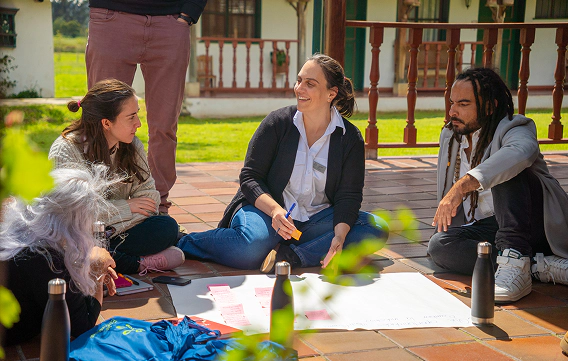
Combining the flexibility of distributed learning with the immersive power of in-person retreats, the MBA in Arts Innovation instills a growth experience for rising cultural executives that is as efficient as it is transformative.

Module Curators

The Arts Innovation MBA curriculum empowers creative industry professionals in multi-dimensional leadership roles with powerful social science, innovation, entrepreneurial, and operational tools for accelerated career impact. The curriculum readies participants for the complex challenges of an evolving cultural sector through its unique balance of foundational coursework, tailored substreams, immersive field studies, innovation summits, applied learnings, reflective labs, and growth-oriented retreats, all curated by top academic institutions to build practical skills and actionable insights.

Cohort by Numbers

Cohort by Numbers

44

Nations

The 2026 Cohort brings together a robust network of dynamic change-makers in the arts across six continents, connecting the best and the brightest.

Roles

Job Growth

By generating more value for their organizations, Cohort Members increase average income by 18% & 32% in the first and second years after the MBA.

32%

Global Perspective

Immersive Fieldwork

accelerates professional growth through hands-on work exchange across cultures & industries.

Innovation Summits 

in Europe and the Americas offer transformative real-world experiences with world-class faculty & peers.

Fellows Snapshots

Global Arts Prize

Recognizing innovation in
the world of culture.

The Global Arts Prize celebrates cultural organizations spearheading an innovative approach to the relevance of the arts in our time. Each year, $60,000 is awarded between two initiatives — regardless of size, location, or focus area — for their contributions to the future of the sector.

Sector Insights

Ripple EFFECT | can arts find new life in second-order impact?

Most cultural strategies are optimized for first-order outcomes: attendance, revenue, engagement. These metrics are visible, reportable, and necessary. They are also incomplete. They tell us who attended, not what changed. The most durable value created by cultural organizations emerges later, often beyond the institution’s boundaries. It shows up as shifts

Read More →

RETROFIT | why is culture hitting rewind?

Nostalgia is often treated as a stylistic trend, but neuroscience reveals a deeper dynamic. Studies show that nostalgic memories enhance emotional regulation, strengthen social bonding, reduce anxiety, and enhance meaning-making. In moments marked by digital saturation and uncertainty, people seek the familiar to feel grounded. This shift is influencing how

Read More →

EFFICIENCY MIRAGE | why do frontline arts cuts keep failing?

Organizations often optimize for what they can measure. Cost savings are clear. Operational efficiencies are easy to document. Human presence, emotional reassurance, and trust-building are not. When leaders undervalue what they cannot quantify, they eliminate roles that hold the experience together. Behavioral economists describe this as a predictable error. In

Read More →

Ripple EFFECT | can arts find new life in second-order impact?

Most cultural strategies are optimized for first-order outcomes: attendance, revenue, engagement. These metrics are visible, reportable, and necessary. They are also incomplete. They tell us who attended, not what changed. The most durable value created by cultural organizations emerges later, often beyond the institution’s boundaries. It shows up as shifts

Read More →

RETROFIT | why is culture hitting rewind?

Nostalgia is often treated as a stylistic trend, but neuroscience reveals a deeper dynamic. Studies show that nostalgic memories enhance emotional regulation, strengthen social bonding, reduce anxiety, and enhance meaning-making. In moments marked by digital saturation and uncertainty, people seek the familiar to feel grounded. This shift is influencing how

Read More →

EFFICIENCY MIRAGE | why do frontline arts cuts keep failing?

Organizations often optimize for what they can measure. Cost savings are clear. Operational efficiencies are easy to document. Human presence, emotional reassurance, and trust-building are not. When leaders undervalue what they cannot quantify, they eliminate roles that hold the experience together. Behavioral economists describe this as a predictable error. In

Read More →