Every day, audiences encounter hundreds of cultural messages.
Event listings. Newsletter subjects. Instagram posts. Exhibition announcements. Most are processed and dismissed before the brain registers them as worth reading.
This is not disengagement, but efficiency.
The human brain uses automatic processing to manage information overload. When incoming stimuli match a familiar pattern — a subject line that announces an event, an opening sentence that introduces an argument, a poster formatted like every other poster — no deliberate attention is required. The brain classifies the signal and moves on.
For artists and cultural institutions, the challenge is not simply producing meaningful work. It is interrupting the patterns that prevent that work from being noticed at all.
A CONCEPT FROM BEHAVIORAL PSYCHOLOGY
The term pattern interrupt originates in Neuro-Linguistic Programming (NLP), a field of communication and behavioral change developed by Richard Bandler and John Grinder in the United States in the 1970s. In its original application, a pattern interrupt was a deliberate technique used in therapeutic and coaching contexts to disrupt habitual thought sequences — breaking the automatic loop long enough to introduce a new response.
The concept has since traveled well beyond its origins. It now appears in behavioral science, communication research, and marketing strategy, where it describes any stimulus that disrupts automatic processing and demands deliberate attention. In digital environments, the same idea circulates under different names: thumb-stopping content, scroll-stopping creative, the hook.
The underlying mechanism draws on cognitive science. The brain continuously compares incoming information against existing mental models. When stimuli match expectations, processing is fast and effortless. When expectations are violated, processing slows. The brain must pause, reorient, and look again.
That pause — however brief — is the moment when attention becomes available.
For cultural producers working in environments saturated with competing messages, understanding how to create that moment has become a practical skill.
Banksy — Love is in the Bin
On 5 October 2018, Sotheby’s London sold a work at auction for £1,042,000. The moment the hammer fell, the framed canvas began to self-shred through a mechanism hidden inside the frame. The work — originally Girl with Balloon — emerged in strips from the bottom of its frame. It was immediately retitled Love is in the Bin.
The auction is one of the most codified rituals in the art world. Bidding protocols, paddle numbers, hammer calls, and salesroom procedures create a predictable sequence of events. Banksy’s intervention violated every expectation built into that sequence at its peak moment of institutional authority. The image of the shredding painting circulated globally within hours. The work was resold in 2021 for £18.6 million. The pattern interrupt had become the work’s defining event.
Tino Sehgal — Constructed Situations
German artist Tino Sehgal creates what he calls “constructed situations”: live encounters staged within museum spaces that produce no objects, no documentation, and no photographic record.
In this Progress, presented at the Guggenheim Museum in New York in 2010, visitors were greeted at the entrance by a child who asked them a question about the concept of progress. As they ascended the museum’s spiral ramp, they were passed between progressively older participants — teenagers, adults, elderly guides — each continuing the conversation.
Visitors arrived expecting to encounter artworks. They encountered strangers who began speaking to them immediately.
The pattern interrupt functioned through format rather than content. No instructions were offered. The situation violated the behavioral script of the museum visit so completely that many visitors did not initially recognize the conversation as the work itself. The constructed situation produced no object to display. The disruption was the piece.
Doris Salcedo — Shibboleth
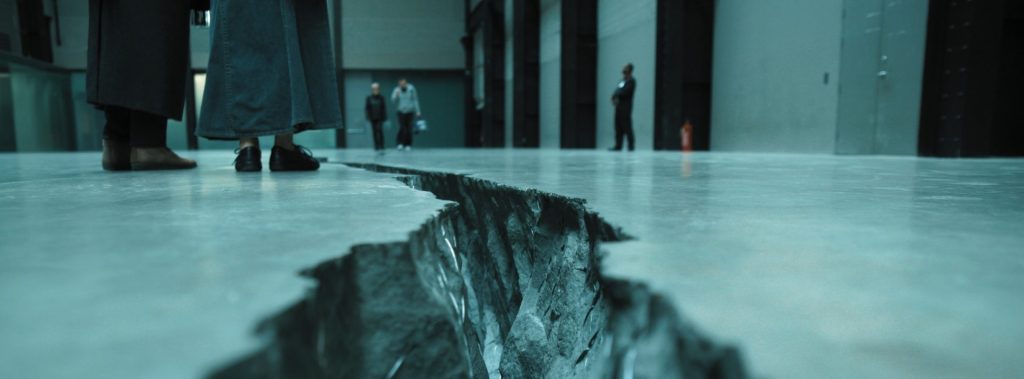
In 2007, visitors entering Tate Modern’s Turbine Hall encountered a crack running the full length of the concrete floor. The fissure — 167 meters long, varying in width and depth — was created by Colombian artist Doris Salcedo and titled Shibboleth. It remained open for five months before being sealed, leaving a permanent scar in the floor.
People enter buildings assuming the floor to be continuous. The crack violated a perceptual assumption so basic it rarely reaches conscious awareness.
Visitors stopped. Crouched. Looked at a surface they had never needed to examine before. Some stepped over it carefully. Others followed it the full length of the hall.
Salcedo’s work carried a precise meaning: the crack represented the divide between first and third world experience, histories of racism and colonial erasure embedded in the surfaces of Western institutions. But the pattern interrupt arrived before any of that meaning was legible. The pause came first. The meaning followed.
WHAT COMES AFTER THE INTERRUPT
A pattern interrupt does not need to be elaborate. It needs to be unexpected.
For communications, this can mean a subject line that asks rather than announces, an opening sentence that resists familiar institutional rhythm, or an image that withholds more than it shows.
For programming and exhibition design, it can mean a work placed where no work is expected, a format that inverts the relationship between institution and visitor, or a physical encounter that disrupts what audiences assume about the space they are entering.
The moment of reorientation is brief. What follows must be worth the attention it creates.
But that pause — before the brain decides whether to engage — is where artists and cultural organizations have more influence than they often realize.
The scroll does not stop because of volume. It stops because of surprise.