Cultural institutions rarely struggle with invisibility. They struggle with predictability.
Audiences carry stable mental models about what a museum, theatre, or symphony orchestra is supposed to feel like. Serious. Canonical. Authoritative. These mental models, or schemas, shape expectations before a visitor ever engages with the work itself.
When institutions behave exactly as expected, those schemas remain intact. When they introduce controlled contrast, perception updates. This is where playful dissonance becomes strategic.
Playful dissonance occurs when an institution deliberately juxtaposes its traditional identity with an unexpected format, tone, or cultural script. The objective is not spectacle, but cognitive recalibration.
WHY PLAYFUL DISSONANCE WORKS
The core mechanism is schema updating. In cognitive psychology, schemas are mental frameworks that organize knowledge and guide interpretation. They allow the brain to process information efficiently by predicting what belongs within a category. A museum, for example, activates a schema associated with reverence, preservation, and formality.
When new information fits the schema, it is easily absorbed. When it slightly contradicts it, the brain must adapt.
Research shows that schema updating is mediated by the interaction between the hippocampus, which encodes new experiences, and the prefrontal cortex, which integrates them into long-term memory structures. Experiences exist along a familiarity–novelty continuum. If an experience is too familiar, it produces no adjustment. If it is too novel, it may be rejected. When it falls in the middle, it prompts integration.
Playful dissonance operates in this optimal zone. It introduces enough novelty to require updating, but enough familiarity to preserve coherence.
The result is stronger encoding, higher memorability, and revised perception. In short, the institution does not merely attract attention. It alters the mental category in which it is placed.
MODELS IN PRACTICE
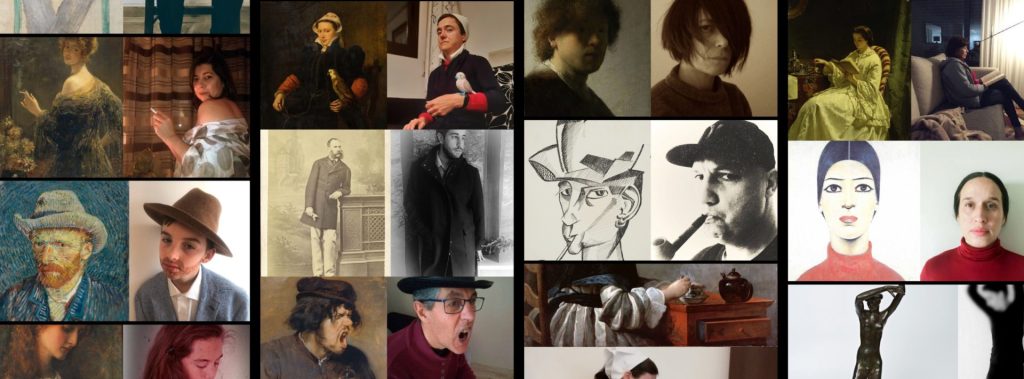
VanGoYourself | Culture24
The VanGoYourself campaign invited audiences to recreate famous artworks using their own bodies and upload the results online.
Masterpieces typically framed as untouchable became participatory reinterpretations. The contrast between canonical art and amateur reenactment was deliberate. It translated museum collections into the grammar of social media culture without diminishing their significance.
The campaign generated widespread engagement by updating the museum’s schema from “observer-only” to “participatory.”
1840s GIF Party | Late at Tate
The 1840s GIF Party invited digital artists to animate nineteenth-century artworks from Tate’s collection as looping GIFs.
Historical paintings were transformed into short, shareable digital formats.
The contrast between Victorian stillness and internet-era animation generated wide online engagement, extending the collection’s visibility far beyond the gallery space.
Inflatable Dinosaurs | Canadian Museum of Nature
To promote its Ultimate Dinosaurs exhibition, the Canadian Museum of Nature placed life-sized inflatable dinosaurs in high-visibility locations across Ottawa, including Parliament Hill and public yoga sessions.
The unexpected appearances were designed for public photography. Residents shared images widely, extending the exhibition’s visibility through organic distribution to their audiences.
BEYOND MUSEUMS
Although these examples originate in museums, the principle applies broadly. Opera houses, orchestras, heritage sites, and theatres often carry entrenched schemas shaped by decades of communication patterns. Their challenge is not only attracting audiences. It is updating perception.
Playful dissonance offers a way to introduce elasticity into institutional identity without compromising credibility. It signals cultural literacy. It lowers intimidation barriers. It invites audiences into reinterpretation rather than passive reception.
STRATEGIC IMPLICATIONS
Playful dissonance should be designed with precision.
It works when:
- The contrast is conceptually coherent
- The institution’s core authority remains intact
- The unexpected format translates the mission rather than trivializes it
Cultural institutions operate within powerful perceptual frames that have been built over decades. Playful dissonance introduces just enough novelty to prompt adjustment without eroding trust. It expands the category rather than replacing it.
The strategic opportunity lies in this recalibration. When institutions deliberately design moments that require audiences to update their expectations, they reshape how culture is categorized in the public imagination. That shift endures longer than any single campaign.
Register for the chance to be invited to apply to The Global Arts MBA