

Worlds Apart? Art-Making & Social Entrepreneurship

There is more common ground than one would expect between the artist’s process and the social entrepreneur’s. At heart, both are deeply concerned with creative problem-solving. Here are three steps that artists and entrepreneurs navigate in short iterative cycles to come up with innovative solutions — Step I: Test One of the hallmarks of both […]
5 Social Innovation Actions: The Stanford Approach

In Module 8 of the GLI Arts Innovation MBA, Stanford University’s Center for Social Innovation provides training to support Cohort Members in becoming more effective entrepreneurial problem-solvers. Here are five key features of the Stanford Innovation approach — Spend Time Framing the Challenge Effective problem-solving starts with creative problem-framing. Before starting to build a […]
Sustained Growth: Three Economic Principles for Creatives

What does the creative sector have to learn from the world of economics? In a world where the cultural sector interacts with everyday economics, here are three economic principles artists and creatives — Paths for Generating Income: Doing and Owning In the 1867 documentary “The Bowler and The Bonnet,” director Sean Connery explores two fundamental […]
Audience Connections: Five Engines of Engagement

Want to engage more with your audience? Navigating the landscape of community building can feel daunting. Here are five ways to help — Moving Connections: A good way to build a community is to bring the audience on the creative journey with you. Look for ways to give them access to processes they may not […]
Overcoming Immunity to Change: A mindset for the arts

Immunity to Change is a leadership framework based on the understanding that the mind, like the body, has an Immune System that regulates to protect us from the stresses of environmental shifts. In essence, the human mind not only filters information but is also the means for processing experiences and creating meaning. Like the Immune […]
The Ecology of Leadership: A new perspective for culture

What does it look like when leaders adopt a down-to-earth approach? What happens to enterprises that observe, analyze, and perform in sync with the environmental context? Navigating change requires understanding the living context of an endeavor. In “The Ecological Perspective,” GLI module director David K. Hurst (Levene School of Business) introduces Arts MBA fellows to […]
How today’s Teaching Artists work
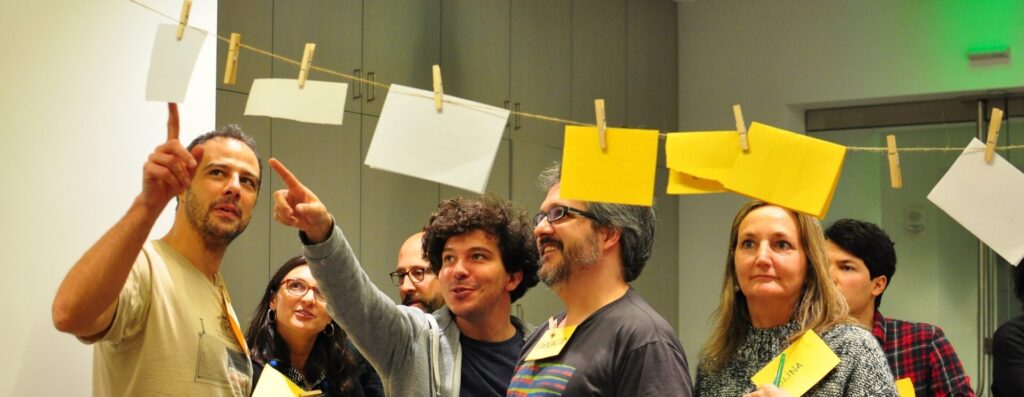
In the late 20th century, Teaching Artistry emerged as a discipline born at the intersection between arts and education. The innovation at the time was the discovery of artistry’s unique potential as a pedagogical tool. Arts-based learning gave audiences an engaging way to learn while participating in a creative journey. Soon, many organizations dedicated to […]
The Business Model Canvas: A tool for creatives

Imagine bringing a complete business plan to life on a single page… Meet the Business Model Canvas (BMC). Created by Alexander Osterwalder, Yves Pigneur, and Alan Smith, the Business Model. Canvas is a lean visual alternative to the lengthy business plan. BMCs have turned conventional wisdom about entrepreneurship on its head, offering entrepreneurs a simple […]
Social Infrastructure: Five uses for creative leaders

Have you ever spent time at a school, a public library, a park, a community theater, or a sports club? If so, you’ve engaged with social infrastructure. Social infrastructure refers to the physical places that shape the way we interact. These places are used for gathering, sharing activities, building friendships across socioeconomic divides, and developing […]
Five ways storytelling helps arts change-makers

Storytelling is humanity’s oldest tool for creating connections, fostering identities, and making sense of the world. In the GLI’s substream ‘Storytelling for Impact,’ storytelling experts David Hutchens and Michael McRay help Cohort Members to make storytelling an integral part of their leadership toolkit. 1. Storytelling connects experience. From the dawn of humanity, stories have […]