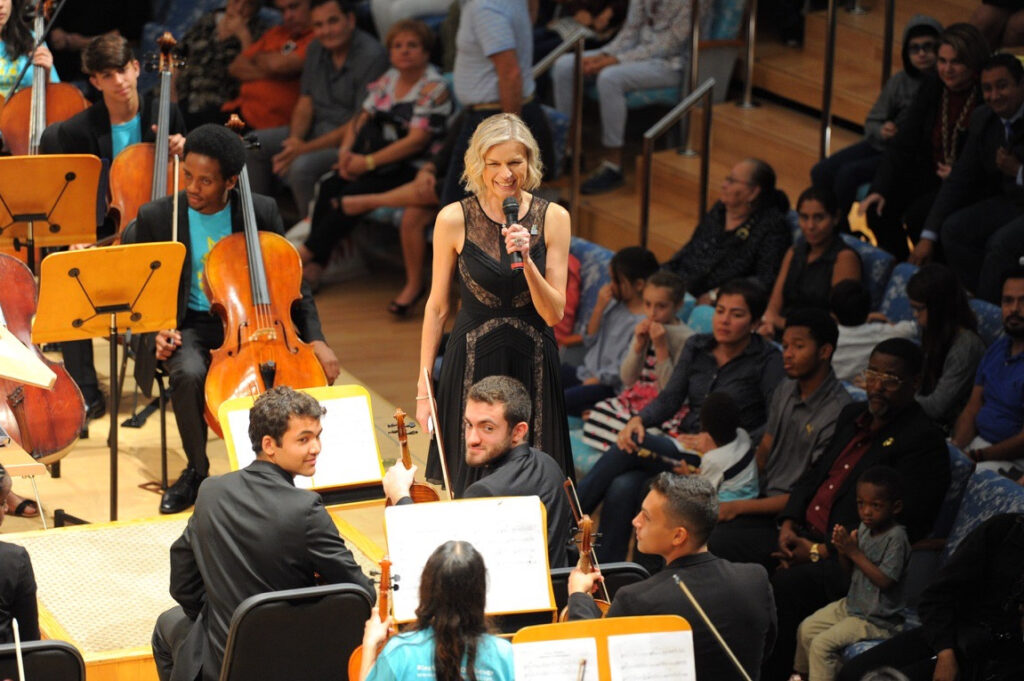

Arts executive, music educator, double-bassist, and activist Anna Klimala works to re-establish music’s central place in the development of young people. Since 2009, Anna has been President of Miami Music Project, a non-profit dedicated to bringing social transformation through music to under-resourced communities. Her work today faces unique challenges and opportunities, given the changes Miami-Dade County has faced in the past three years.
Miami Music Project provides Miami’s under-resourced youth with unique opportunities to participate in music that provides a creative outlet and further develops their social and emotional skills. The program’s most significant objective is not to create musicians but to use intensive musical study to build skills that uplift students in communities with untapped potential. Children receive the tools to positively impact their communities and develop the skills to navigate their future.
Miami Music Project is a free after-school program conducted in low-income and immigrant neighborhoods daily. Busing is provided across Miami-Dade County, serving over 750 students annually, and over 360 hours of musical programming are provided annually per child. This feature is particularly unique since Miami-Dade represents a territory difficult for an arts initiative to address fully: not only is Miami-Dade County a vast territory, but it is also a challenging one due to its ever-changing social fabric.
Miami-Dade has historically been one of the big doors into the United States. While the population has been growing steadily since the second half of the 20th century, the years 2020-2022 have seen an acceleration of newcomers from other states in the US choosing Florida. In 2022, Florida presented the country’s most significant inbound net gain, receiving 318,855 people, making the population grow to over 22 million people (a 1.9% increase representing the largest of any US state over this period). Miami-Dade County was the metro area with the second-largest inbound moving rate in 2022. This phenomenon has brought significant capital to Miami-Dade, immediately increasing the demand for housing and driving up rent prices by 25% in 2021-2022, making Miami unaffordable for many locals.
Despite this current phenomenon, according to the last census in 2021, 54% of Miami-Dade County’s population is foreign-born. Miami-Dade is a popular starting point for Latin American and Caribbean immigrants in the US; it is impossible not to hear or read Spanish or Haitian in the city.
An article from Migrationpolicy.org from June 2022 reveals that throughout the 2015-19 period, Miami-Dade was the city that housed the biggest Caribbean community in the US, receiving 864,800 Caribbean immigrants from countries such as Cuba, the Dominican Republic, Jamaica, and Haiti. Another article written in 2022 by Migrationpolicy.org delves into the increasing arrival and diversification of Latin American immigrants in the US from countries such as Argentina, Brazil, Chile, Colombia, Ecuador, Peru, Venezuela, etc. While more minor in proportion, representing only 8% of the 44.9 million foreign-born in the United States, by 2020, 27% of South American immigrants in the US have resided in Florida. Miami-Fort Lauderdale-Pompano Beach areas present the highest concentration of South American immigration in any metropolitan area in the US, consolidating 8,8% of the total, receiving 538,000 immigrants from 2015 through 2019. In sum, multiple sources agree that 70% of Miami-Dade is Hispanic, out of which 66% are foreign-born, according to the last census performed in the US.
Anna Klimala is well prepared for this challenging demographic: she holds a master’s degree in music education. She has trained at the executive education and leadership development programs of Columbia Business School and Harvard Business School. But most importantly, she understands the importance of articulating this multicultural setting into an intercultural educational experience. Miami Music Project sees cultural differences not in terms of extensive homogenous inclusion but in dialogic terms with these diverse cultural heritages. This perspective is evident at first glance in Miami Music Project’s choice of musical repertoire inspired by the communities it caters to, but also, at a deeper level, in its mission to nurture agency in these young civilians through art.
GLI: We’ll begin with some big questions. What do you think is the current role of the work of art in today’s world?
AK: I sincerely believe the arts must be integral to people’s upbringing. But it also needs to be a part of adult life. It is a refuge; it has therapeutic qualities. It makes us think; it makes us flex our thinking muscles. It allows for broader conversations. Art can stimulate us and create deeper engagement, deeper thinking. Engaging with art is like a journey, a departure that we come to love as soon as we can return from it, and we appreciate this realization of how much we’ve detached. I don’t understand how people can live without art. Still, I also think many people may not see the art already around them, especially in Miami, which is home to incredible artists and innovative art-making. Seeing a mural while driving — that is someone consuming art.
GLI: Can art promote social change?
AK: Absolutely. That is one question that will receive massive yesses in our workspace. It promotes social change within the art makers, their families, and entire neighborhoods. I cannot help but think about a letter I received from two parents with words of gratitude for the unity that music created to bring the family together. Families participate in their children’s education: by seeing them perform, practicing with them, and cheering them on. Art is social change. I can see the difference this program inspires and what I do. I feel that once you go somewhere, you can never undo it. Once your mind and heart open, you change for life.
GLI: You’ve mentioned families participating in the artistic process… what does it mean to activate artistry in everyone?
AK: Activation gives you a different dimension. In El Sistema, a famous quote says, “If you put a violin in your hands, you will not pick up a gun.” There is an emotionality in the art that is unique. It makes you open to broadening your horizons, going deeper into yourself, and discovering new things about yourself. It helps you sit with your emotions better; heal emotional wounds. With more music education, we could have more mentally healthy people worldwide. We often overlook how incredibly developmental art can be, not just music.
GLI: What does it take to make that happen? What do you look for in your teachers and collaborators to make that happen?
AK: We are a music program that aims to produce social change. We strive for wholesome participation in society; we want people to understand there is more to this than making music. What children bring to the classroom, their mood, and their behavior reflect their daily circumstances. We have that in mind when they show up and invite them to vent all that in a classroom. While all teachers at Miami Music Project are highly skilled professional musicians, they are also profoundly aware of the complexities we must shoulder to help children through their trials and tribulations. After all, they deeply need connection.
Professional musicians are only sometimes trained to be educators. With this in mind, we provide a lot of training for educators through the Teaching Artists Training Institute, of which I am a co-founder along with Mike Angell, Stanford Thompson, and Seth Truby. This program helps teach 200 teaching artists nationwide in live and virtual workshops.

GLI: Let’s turn to your leadership. You’ve mentioned in previous articles that, on the one hand, you’ve always embraced leadership as a child and, on the other, that your arrival to the US has meant acquiring specific skills such as fundraising, budgeting, project management, human resources and more that have prepared you for this calling. Can you describe what the departure from artist to arts leader feels like? Was there a decisive moment for you?
AK: I love this question. I come from a small town in Poland. When I went to study music, I had the choice of double bass or bassoon. I had yet to learn what a bassoon was. When I met the double bass teacher, it felt right. From then on, I trained to become a professional musician; I knew I wanted to do that. When I went to college to do my master’s, I initially wanted to study bass, but there were no open spots in the year I wanted to audition. I enlisted in music education with the idea of transferring later. Although it was incredibly challenging and demanding when I started immersing myself in music education, something happened then. The moment I got into a classroom, something changed in me. As much as I thought I was a mismatch for a musical educational program, I felt like a fish in the water in the classroom. It was so natural; everything I studied flew out of my head, and I remember my professor noticing how teaching was natural to me. I discovered having a talent that felt like a natural thing.
I also felt interested in structures, understanding how to run things, managing administration, the decision-making. I’m a born activist and a learner; I always want to know more. I always thought I could do things better when I started playing in orchestras. Working as a musician, I noticed that I would devote myself entirely to it as soon as I had some responsibility. I like the learning opportunities that commitment brings.
There is a cyclical aspect to orchestra life that is reassuring to many but terrifying to me. I started a festival in Poland and managed every part of it. So, in a way, I’ve always been performing this leadership role. However, as soon as I got the job at Miami Music Project in 2009, I knew I would have to learn a lot. But I knew immediately that this role reunited everything I had been working towards.
GLI: What drew you to Miami? What is it about Miami that inspires you?
AK: As soon as I finished my studies at USC, I chose to live in Miami. Miami is my home, where my identity is. It is where I feel most natural. I love the weather. It is my habitat. I love the multicultural aspect of Miami. There is a laid-back culture. My day can be hectic, but I get in my car, see the ocean on my drive home, and its overwhelming beauty takes me.
People viewed Miami as incredibly young for the arts for a long time, but the arts have exploded in the last 15 years. What is happening in Miami is unique within the US. I love getting to know cultures. I feel like Polish, Latino and Caribbean cultures are symbiotic.
GLI: As we both know, Miami is challenging for arts initiatives. Settlements disperse, and the social fabric keeps changing every five years. Arts initiatives need help to cater to so many differing publics at once. What is your secret?
AK: I would have agreed with this question 10 years ago, but things changed so much over the past decade. Many arts initiatives are pushing the envelope. In the Miami Music Project, we have focused on the quality offerings of the students, making sure that we connect with the families and making sure that we fight for them. We say no every time we get offered that our children play in the background as “background music.” The communities we serve deserve to be front and center.
As a nonprofit, we must think of ourselves just like a business. We operate on funds that somebody else gave us. Why would I make a poor effort to make this money count? We work to bring Miami Music Project to the most excellent standard. Accountability is essential to us. In Miami, this can set you apart.
GLI: How do you gain insights into the communities you work with? Are there any fundamental human truths to people turning to music in Miami?
AK: Regarding insights, we like to ensure that when we enter the communities we serve, we try to understand the community itself. Sometimes organizations try to step into communities and say, “I’m going to fix you.” That is not our approach. We come to a community and say: “How can we help?.” These communities have had so many saviors; that approach never works. We pay attention to them and do a good job listening to their needs.
When you look at Miami, we are all immigrants! Many Miami immigrants have intense and painful stories about getting here. And there is something in there that is why people turn to music so much because of that deep pain. Miamians are exceptionally responsive to music. You hear salsa or bachata played on the street, and immediately people start dancing. People appreciate life because of their struggles.
GLI: What challenges do you find in the progressive gentrification of Miami? Can art address any of these?
AK: We see it in most of our communities, and it is heartbreaking. What most people think makes our city better makes someone else lose their home. People are paid to leave, put on a bus, and sent somewhere else. We have seen that in Little Haiti, where gentrification is very aggressive. Gentrification promises a commitment to low income, and low income never makes it in those scenarios. We’ve seen so many people leaving our programs because they cannot remain in Miami.
I don’t understand why the city can’t develop with its people. Why does it have to be at the expense of the people? While I appreciate the government’s efforts to change this situation, I don’t think these efforts are enough.
GLI: Your experience as a Board Member and Treasurer of El Sistema USA suggest that El Sistema has provided Miami Music Project with a framework for social development. Have you adapted the El Sistema model in any way to address the cultural realities of Miami? Have there been any adjustments to engage better and nurture these young performers?
AK: We don’t call ourselves an El Sistema program; we are inspired by El Sistema’s philosophy of serving those with the greatest need. There are a lot of Venezuelan expats, and there is great expectation with that brand. El Sistema is a fully government-funded initiative in Venezuela, and we’re nothing like that.
Adaptation to local reality is essential. In repertoire, we make sure that throughout the year, we find certain pieces or arrange pieces according to the culture we serve, Haitian and Latin music; we make sure that these cultures are valued and addressed. We also adjust to other after-school programs in the area or programs provided by the schools. We should be mindful of the schedules. We integrate this adaptation into our hiring procedures: we may hire someone already working for these kids’ schools or living in the community we serve. We customize the learning experience to family needs.
GLI: You work closely with one of our Module directors, Stanford Thompson. What are you guys working on, and have you ever discussed the Logic Model together?
AK: Yes! We talked about the logic model many times! Being colleagues and having run two of the oldest and largest El Sistema-inspired programs in the country, we check in with each other and brainstorm constantly. He is also one of the co-founders of the Teaching Artists Training Institute we developed together. He is a cool guy, incredibly thoughtful, and helpful; I always appreciate brainstorming with him. ▣